The Start-Up vs. The Corporation February 28, 2006
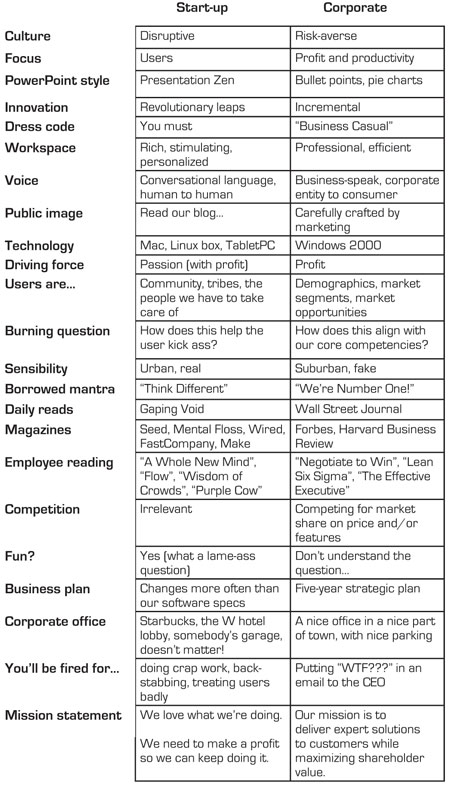
Kathy Sierra over at Creating Passionate Users created the chart below which illustrates the differences between the small start-ups we run, versus the large corporate powerhouses. An interesting point she made is that "When you evolve out of start-up mode and start worrying about being professional and dignified, you only lose capabilities. You don’t add anything…you only take away. Dignity is deadly."
We’ve all made mistakes
And I’m sure if they were all caught on tape they’d be just as entertaining as this video. It’s a collection of Steve Jobs’, and a couple buddies’, bloopers on stage.
OMG - It’s Hammertime!
That’s right, MC Hammer has a blog! His, his, his blog hits me so hard. Makes me say "Oh my Lord".
Tongue Biting
37 Signals threw up a great post reminding us, that if Ford had asked everyone what they wanted, they would have said a faster horse.
Original iPod announcement thread at MacRumors
"I still can’t believe this! All this hype for something so ridiculous! Who cares about an MP3 player? I want something new! I want them to think differently! Why oh why would they do this?! It’s so wrong! It’s so stupid!"
"gee! an mp3 player with a HD! how original! kinda reminds me of a JUKEBOX i once knew."
"I’d call it the Cube 2.0 as it wont sell, and be killed off in a short time…and it’s not really functional."
"All that hype for an MP3 player? Break-thru digital device? The Reality Distiortion Field is starting to warp Steve’s mind if he thinks for one second that this thing is gonna take off."
"There are already two products similar to this on the market. The Nomad Jukebox and the Archos Jukebox which can come with a 20 gig HD. The iPod is obviously alot cooler and has firewire, but it is far from revolutionary. I for one am disappointed and think that apple is making a mistake by trying to get into this market."
Apple should have just listened to their customers and never released the iPod.
Why Features Don’t Matter Anymore
This is a very interesting article on features in technology and the need for less. Here’s the original article.
WHY FEATURES DON’T MATTER ANYMORE: THE NEW LAWS OF DIGITAL TECHNOLOGYby Andreas Pfeiffer, principal of Pfeiffer Consulting, an independent technology research institute and consulting operation focused on the needs of publishing, digital content production, and new media professionals.
Technology Trends
The iPod was never sold on the grounds of its technical merits: Apple hit a gold-mine by marketing a cool new way of integrating music in your life. Even when Apple announced the iPod with video, it presented it not as the best multi-media player in the universe, but as a cool new way of watching "Desperate Housewives" and other TV shows.
In the seemingly never-ending debate about Apple’s successes, announcements, new products and predicted-but-unannounced über-gadgets, features and technical specifications often seem to dominate the debate. Yet if there’s one lesson to be learned from the company’s recent successes, it is a very simple one: features don’t matter any more.
Welcome to the Age of User Experience.
One key aspect of modern digital devices is that technical specifications are easily copied and replicated: mega-pixel count in cameras, storage capacity in music players or processor speed in personal computers are the same everywhere. As a result, they provide only poor distinguishing factors for consumers when it comes to choosing between different brands.
That’s where the overall user experience comes in. As computing and digital devices move more and more into the consumer space, features and functionalities will increasingly take the back-seat as motivators for technology adoption: as the iPod abundantly shows, user experience (along with a strong brand, and clever marketing) is much more important for the success of a device then technical specifications. Web designers have grasped the importance of good user experience a long time ago; now it is time the big technology providers to understand where the industry is headed.
10 fundamental rules for the age of user experience technology:
1) More features isn’t better, it’s worse.
Feature overload is becoming a real issue. The last thing a customer wants is confusion-and what’s more confusing than comparing technical specifications, unless you are en expert? Only nerds get a kick out of reading feature lists. (I know - I’m one of them.)
2) You can’t make things easier by adding to them.
Simplicity means getting something done in a minimum number of simple steps. Practically anything could be simpler - but you don’t get there by adding features.
3) Confusion is the ultimate deal-breaker.
Confuse a customer, and you lose him. And nothing confuses more easily than complex features and unintuitive functionalities.
4) Style matters
Despite what nerds may think, style isn’t fluff. On the grand scale of things, style is as important as features-if not more so. Style and elegance can contribute significantly to a good user experience. But style isn’t just looks, it’s a global approach. Fancy packaging isn’t enough.
5) Only features that provide a good user experience will be used.
Why did the iPod catch on? Because it was so self-explanatory, and it remains the market leader in terms user experience. Sure, it may be excruciatingly difficult to make devices like digital media players or computers easy to use; but if a product is complex, intimidating or confusing, its chances for success are minimal.
6) Any feature that requires learning will only be adopted by a small fraction of users.
Learning new features, even the ones that a user might find interesting or intriguing, is a real issue: nobody has time. Getting consumers to upgrade and adopt new features is one of the biggest problems software publishers face these days.
7) Unused features are not only useless, they can slow you down and diminish ease of use.
Over time products become convoluted and increasingly complex to use. The frustration of not finding the one feature you need among a flurry of stuff you don’t need, want or even understand, can be considerable. (Ever heard of program called Word?)
8) Users do not want to think about technology: what really counts is what it does for them.
The best tool is the one you don’t notice. Why do you think pen and paper remain vastly popular for brainstorming? Because you don’t have to think about them. Pencils don’t crash.
9) Forget about the killer feature. Welcome to the age of the killer user-experience.
When technology achieves something desirable without being in your face, when it know how to integrate itself into you wishes and desires without distracting from them, that’s when technology lives up to its potential. Unfortunately it’s not that simple to get there.
10) Less is difficult, that’s why less is more
Let’s face it: it’s usually harder to do simple things exceedingly well, than to just pile up features. The 80/20 rule applies here too: do well what 80 percent of your users do all the time, and you create a good user experience.
Seth Day on YGG
We might as well call today Seth Day, because here’s another post courtesy of Mr. Godin who seems to be in the mood to write today. It’s an amazing quote of a quote of a quote. I guess that’s a " ‘ "quote" ‘ ".
Today Tom Peters quotes from one of my favorite books, The Art of Possibility, "A shoe factory sends two marketing scouts to a region of Africa to study the prospects for expanding business. One sends back a telegram saying, SITUATION HOPELESS STOP NO ONE WEARS SHOES. The other writes back triumphantly, GLORIOUS BUSINESS OPPORTUNITY STOP THEY HAVE NO SHOES."
Edges and Clusters - Seth Godin
I’ve read and enjoyed just about every single book Seth has ever written. And by doing so It’s now become a natural habit of mine to incorporate the word Edgecraft into nearly every other business/advertising conversation I have. So it’s only natural for me to post Seth’s latest blog entry which references Edgecraft.

Most organizations have a sweetspot. That’s the product or service that leads to highest profit, retention, customer satisfaction and word of mouth. If you walk into a certain bar and order a draft beer, you’re more likely in that sweetspot than if you ordered, say, a Coke. A different bar might discover that the customer that orders a top-shelf martini is most likely to lead to the best outcome.
Over time, you’ll start to develop slight variations on your sweetspot. If one kind of martini is good, then a few are even better. Pancake houses start selling Swedish, German and even Brazilian pancakes. Insurance companies start selling a dozen different variations on whole life.
Clusters work because people are likely to be drawn to a crowd. They also work because making a good, better, best comparison gives us the confidence to go ahead and buy something. It’s not an accident that profitable products like cars come in so many variations-having a choice makes it easier to choose (at least for a while). When Heinz comes in four colors, you don’t have to decide whether or not to buy ketchup… you merely have to decide which color, and they win every time.
Clusters have a few problems. The first is that you inevitably leave people out. If your restaurant serves nothing but spicy food, then the odd duck who came with a group and doesn’t like spicy food is going to go away unhappy.
Clusters get boring. If all you’ve got is another variation of the same fundraising tool that’s worked so well for you, it’s hard to get a meeting with me (again).
And most of all, clusters make it hard to develop new sweetspots. First-class long-haul travel was a great sweetspot for Pan Am, but when the world changed, they got hammered.
So, consider this: not just clusters, but edges, too.
Maybe your bar ought to start selling amazing hot chocolate.
It’s hard to make outliers, because it’s so tempting to gradualy work your way over, making each new product an extension of your sweetspot. That doesn’t work. It just adds skus to your life.
An edge needs to be sharp and abrubt and distinct in order to generate the light it needs to thrive.
Here’s the link to the original post and a trackback URL.
Goosebumps February 27, 2006
You may have already seen this video, but it is still worth rewatching and all of the blog and media attention it’s getting. A writer could never write a story this great.
Click on the image or here.
NOTE: The broken video link has been fixed.
BzzAgent & Their New Channel February 25, 2006
I’m subscribed to the WOMMA newsletter, which they send out periodically. Alot of great info about WOM marketing. But it was the latest #1.41 that caught my real attention.
It was "BzzAgent Launches New Word of Mouth Channel". You can see the press release here.
Then I became concerned. The first thought that came to my mind was the question, "Is BzzAgent just using the people in its network?". I personally believe BzzAgent is a hypocritical company, but I’ll save that for another day.
This new service most of all gives off the impression that BzzAgent is pimping their network. Here they say it themselves:
The BzzAgent media channel enables advertising, marketing and public relations firms to purchase access to BzzAgent’s growing community of more than 130,000 consumer volunteers just as they would buy time on a broadcast network or space in a publication.
Buying access to use people in such a way, on top of that volunteers, is very degrading. I don’t care how much success BzzAgent has, when a company does such unethical things, you will cause disappointment. Now we have to remember BzzAgent is a business and their goal is to acquire money. It is not entirely possible to have a money machine based on complete ethics. So BzzAgent, don’t lie to people about your ethical practices, be honest, and live up to your creed.
I, most of all, want to know what the BzzAgents themselves have to say about this, it seems that individuals are just giving up their integrity to this company. A company calling you just some "space" and "time" that people can buy. Are you going to let people buy you off like that?
It’s just so wrong. What you think?
Seek Out / Keep Out
I just read a really interesting post at just a blip, Baba Shetty’s blog. Although the point he makes references the ad industry, it’s something that should be applied to all of our marketing efforts and creative endevaours. Create something worth seeking out.
| older posts »When we were at Fallon together David Lubars used to explain the logic of BMW Films with the phrase ’seek out’. As in, ‘what if we reversed the polarity of advertising and created stuff that people would seek out.’ I always thought that was pretty good.
So I’m going to do an open source thing with David’s phrase — I’ll add the ‘Keep out’ part as the flip side of it. It’s really the two sides of the coin that describe the dominant media behavior of the era. Consumers today can be more purposefully intentional in their consumption of products, services and media by seeking out – via search, online recommendations, endless browsing, and subscribing to content or people networks. But simultaneously they’re filtering out of their field of attention everything they don’t want — via DVRs, the ‘do not call’ registry, spam and popup filters, noise-reduction headphones and iPods. And of course the biggest filter of all, the simple refusal to pay attention to anything that isn’t useful or doesn’t delight.
Simple enough proposition. Either create something worth seeking out, or you will be kept out.