It’s been quiet. A little too quiet… April 19, 2006
We haven’t forgotten about the cool clique that reads our blog. We’ve been busy working like madmen on the new YGG, which’ll tie the blog right into the main site. I have a few entries I’ve written, but am going to save them for the new site.
So we appologize to anyone and everyone that drops by here every once and a while. We’ll just call this lack of posting activity a strategic creation of suspense for the new YGG.
Facebook beats Myspace March 29, 2006
Is it possible that a website with less monthly visitors and pageviews than it’s competitor can fetch a price more than double the price the better competition did. Well in this day and age that is a huge possibility, Facebook.com turned down an offer for 750 million and is hoping to get 2 billion, which basically doubling the 580 million NewsCorp paid for Myspace.com. So I guess in the world of business you don’t have to be the best, to be the most profitable.
continue reading article via Business Week
All you MBA’ers are Liabilities March 21, 2006
You heard it here, staright from the AdAge horse’s mouth.
MBA’S MAY BE A MARKETING LIABILITY
New Study Finds Those With Degrees UnderperformMarch 21, 2006
By Jack Neff
CINCINNATI (AdAge.com) — A Master of Business Administration degree is not only worthless, it can work against a marketer, according to a survey of marketing executives from 32 consumer-products companies by consulting firm Ken Coogan & Partners.
The study found that marketing executives from underperforming companies were twice as likely to have been recruited out of M.B.A. programs than marketing executives from out-performing companies.
The study used scanner and panel data from VNU’s ACNielsen to show marketers from companies with significant market-share gains are far less likely to have M.B.A.s than those from companies posting significant share losses.
Major marketers
The M.B.A. factor wasn’t the only difference, but it was perhaps the most striking one between winners and losers among the companies, which included General Mills, Kraft Foods, Nestle, Pfizer, Clorox Co., Reckitt Benckiser, Energizer, Alberto Culver Co., Hasbro, Cadbury Schweppes, Kodak and Dunkin’ Donuts.
Marketing executives from 18 underperforming companies — which had sales grow 7% less than their categories on average in the two years ended August 2005 — were twice as likely to have been recruited out of M.B.A. programs than marketing executives from out-performing companies, which averaged growth 6.2% faster than their categories over the two years. Of executives from underperforming companies, 90% had M.B.A.s vs. 55% at outperforming companies.
Not all master’s degrees appear worthless in the study. Just M.B.A.s. About 10% of the marketing executives at the out-performers had master’s degrees other than M.B.A.s vs. none at underperformers.
That twice as many underperforming companies as out-performing ones participated in the survey may indicate something, too. Possible theories: Underperforming executives, particularly ones with M.B.A.s, spend more time filling out surveys, or are more likely to be in contact with consulting firms like the one that administered the study.
Recruitment practices
The out-performers in the survey got about a fifth of their marketing executives from undergraduate programs and another fifth from advertising or marketing agencies or other industry vendors. None of the executives from underperformers had been recruited as undergrads and only 5% came from agencies or suppliers.
Perhaps surprisingly, the out-performers were understaffed compared to their underperforming peers. Out-performers averaged one marketing executive for every $37.9 million in sales, compared to one for every $28.5 million in sales at the underperformers. But the out-performers spent more on marketing—averaging 12.4% of sales vs. 11.6% for the underperformers.
Ken Coogan, principal of the consulting firm, isn’t sure the marketing-budget differential is significant, but believes the staffing number might be. Possibly, it reflects staffing at both out- and underperformers not having caught up yet with their changing marketplace results, he said. But he said too much staff — and bureaucracy — could actually be slowing down the underperformers.
Outsourced marketing services
In a separate bit of counterintuitive research, Mr. Coogan said he has found marketers that outsource marketing-services functions the most actually have higher staffing levels than ones that outsource less.
Though they don’t value M.B.A.s as much, out-performers in the survey place a much higher value on personal and professional development once they hire people. The survey showed the share winners far more likely than the losers to support attendance at industry conferences and seminars, involvement in industry associations and peer-share groups, internal training groups, formal mentoring programs and graduate-level seminars.
The only professional-development perks supported more by the underperformers were — you guessed it — executive M.B.A. programs.
Equally unsurprising, executives at the out-performing companies were far more likely to believe career advancement at their companies was based on merit rather than politics. Underperforming marketers were more likely to see politics at play. Overall job satisfaction measures were higher at the out-performers.
Stock option differential
But executives were about equally happy with compensation at both the winners and losers. And the underperforming marketers were more likely to offer stock options than the out-performers. Both findings could create some interesting fodder for executive-compensation critics.
Retention programs that were more common among the out-performers than the underperformers included assignments outside marketing to groom for general management, part-time or job-sharing assignments for managers who request them and giving more tenured executives preference in job assignments.
The Classic 1-2-3: Ries Style March 20, 2006
The strategically lovely Laura Ries at her best:
Strategy is strategy. Tactics are tactics.
A strategy should never change. Tactics should be changed frequently to adopt the new ideas, new concepts, new opportunities and new media that are constantly coming into the market.
But guess what? Company after company tries to win their marketing wars by constantly changing their strategies. The latest example is General Motors.
Years ago, General Motors had a brilliant strategy. Chevrolet was the entry-level car. Pontiac was the youth-oriented car. Oldsmobile was the high-technology car. (No really, the now defunct brand was cutting edge at one time. In fact, it was the first high-volume front-wheel-drive car.) Buick was the conservative car. (Bankers drove Buicks.) And Cadillac was the high-end, expensive car.
Today, everything is a mess at General Motors. Nobody knows what the individual brands stand for.
What is GM’s entry-level car? Is it Saturn or Chevrolet?
What’s the difference between a Chevrolet, a Pontiac and a Buick? Not much since the brands share many models with the only difference being the nameplates.
In Friday’s New York Times, Ryndee Carney, GM’s manager for advertising and marketing communications said that the divisions “operate independently.”
A big mistake. Strategy should be dictated by the corporation. The divisions should only have the freedom to determine their individual tactics.
If a company wants to be successful with a multiple-brand approach, it should set rigid rules for the strategy of each brand and then let each brand manager determine the appropriate tactics to execute the strategies dictated by the company.
In many categories, a company can be successful with what we call a one-two-three approach.
1. An inexpensive brand.
2. A popular-price brand.
3. An expensive brand.
Today, Toyota is a company flying high. Toyota has built the classic 1-2-3 strategy with
1. Scion
2. Toyota
3. Lexus.
Other companies with 1-2-3 strategies:
- Busch – Budweiser – Michelob
- Old Navy – Gap – Banana Republic
Price isn’t the only way to build a unified company strategy. You can distinguish your brands using age, MTV is for hip teens, and VH1 is for hip adults (or hope they are still hip.)
You can distinguish by skills. Black & Decker is the consumer brand. DeWalt is the professional brand.
Or you could distinguish by distribution. L’eggs is the panty hose brand sold in supermarkets. Hanes is the brand sold in department stores.
If you appeal to no one, you are forced to sell your product on price. Not a very efficient or profitable way to run a business. A strong narrowly-focused brand helps to differentiate your product and makes the selling process easier. Strong brands attract consumers; weak brands need to be forced upon consumers with advertising and low prices.
Toyota is has done a brilliant job of building distinct brands. Toyota’s latest brand winner is Scion. In 2005, Scion spent the fewest in media dollars for each new vehicle sold at $284. Toyota was $422 and Lexus was $875. Compare those numbers to some of GM’s cars and you see the power of strong branding. Buick was $751, Saturn was $1012, Saab $2,116.
The introduction of Scion in 2003 has been brilliant. Toyota made great use of viral marketing and event sponsorships instead of advertising to build the brand the buzz surrounding it. Other brands have tried viral marketing, but the technique only works if you have a credible brand, a unique message and can target a narrow audience. Scion has all three and the brand completes the Toyota trifecta.

Here’s a link to the original article.
Success & Motivation - Don’t Lie to Yourself March 18, 2006
A nice post courtesy of the Cubanator, Mark Cuban.
I learned a lot from Don Nelson when he was coach and GM of the Mavericks. He told me something early on, that opened my eyes. I forget the exact conversation, but we were talking about players, and I asked him why he didnt talk to a specific player about something that was going on. What he said was that “THe worse evaluator of talent is a player trying to evaluate himself.”
The same applies to business people and particularly to entrepreneurs and want to be entrepreneurs. We tend to be less than honest with ourselves about our strengths and weaknesses.
I have been just as bad at this as anyone, particularly when I was getting started in the business world. For those of us who dream of starting and running a business, we know that we have to have a level of confidence in our own abilities. We dont want to believe that there are things we cant do. We want to believe that if we try hard enough, work long enough, and get a little lucky, that the sky is the limit. The problem is that we let our confidence cloud our judgements of what we truly know about ourselves.
Im one of the least organized people I know. Today, i have an assistant and others that help me run my life. If you ask me where IM going to be in 3 days. I have no idea. I do know that i have a kick ass assistant who is going to make sure that when i wake up that morning, I know where Im going and how to get there.
When i was 23 years old, sleeping on the floor and starting MicroSolutions, no assistant. No organization. I was a procrastinator. Accounting was a shoebox of receipts. I was a mess.
But I lied to myself and said that I could deal with it. That i would make time to get it all figured out and organized. That if I only set my mind to it, I could be a detail person. I could stop procrastinating. It doesnt work that way.
I did the things I was good at. I could sell. So I sold. I could write software programs. I could integrate PCs. I could set up local area networks. And I did. My business grew. But it also grew out of control A local area network or a software program without documentation is a disaster waiting to happen. And they did. Not to the point where it killed my business, but to the point where I spent far too much time fixing things rather than selling new deals.
Fortunately, one of my best customers at the time was interested in becoming a partner in my business. Martin Woodall ran a company called Hytec Data Systems. He was not only smart and a good programmer, but he was the most anal, detail oriented person I had ever met in my life. The perfect partner for me.
Our partnership wasnt always easy. We had more than our shares of knock down drag out fights. He of course would want everything done with precision and if lack of perfection was an option, he didnt want to do it. I of course was the exact opposite. I was the GO FOR IT guy. We can sort it out after the fact. We were perfect partners. We knew and trusted the skills of the other and although many might not think yelling was the best way to work things out, we managed.
It all came down to choice. I had the choice between lying to myself and pretending that I could turn on a switch and become a details person, or accepting the fact that Im not, and partnering with someone who is. Continuing to lie meant I would probably lose my business.
Every entrepreneur faces comparable choices. Each of us has to face the reality of who we are and what we are.
What choice will you make ?
Entrepreneurial Proverbs March 8, 2006
Marc over at O’reilly Radar just posted an insightful list of "Proverbs" that should be taken to heart by every entrepreneur. The full post is below, and a direct link to the original article can be found here.
I gave a talk at ETech on Monday called "Entrepreneuring for Geeks." I’ve given this general talk a few times now — how can the more technically minded among us move into making companies of our own? I really enjoy the talks because I really enjoy entrepreneurs; at least, I enjoy the ones who are really excited about making something fantastic through their efforts. "Do you want to sell sugar water for the rest of your life, or do you want to change the world?" Right.
I started out this year’s talk with a set of "proverbs" I’ve collected or thought up over the years. I liked the format of a Go book I recently read, called (not surprisingly!) "Proverbs," and decided to adopt it for the talk. These are basically little nuggets of wisdom for bite-sized nutrition. Enjoy.
Starting
- It’s good to be king — being an entrepreneur is the best job I’ve had. Every day your job is new and different; you constantly have to push yourself in new directions. You no longer have to say, "Well, I’m just an engineer, but…" — you have a great excuse to take an interest in everything. Working in an environment you shaped to your own beliefs about how a company should be run is incredible (and humbling!). And of course there are sometimes financial rewards, although it’s still a great job regardless.
- Losing sucks — shutting down a company is unbelievably difficult. It affects your home life, your health, your job prospects, your financial stability. Professional investors are grown-ups, but it’s still extremely disheartening to lose the money people invested based on belief in you. If your backers include friends or family, it’s extremely difficult to have to tell them the company is closing and their money is gone. Most entrepreneurs fail several times before succeeding, too, so losing is both terrible and nearly inevitable. Fight as hard as you can against it.
- Building to flip is building to flop — this is taken from Jason Fried, and he’s right. People who start out with only one goal, to sell to a big portal, will find their options are too limited. Plan as many paths to success as possible for your company, and always have a Plan B when acquisition (or whatever path you choose first) doesn’t work.
- Prudence becomes procrastination — it’s great to research your market and talk to potential buyers about your ideas. It’s terrible to let an excess of this become a impediment to getting started. Too much prudence edges away from research and into procrastination.
- Momentum builds on itself — just start. Do whatever you can. Draw a user interface. Write a spec. Make something, anything, that people can see and touch and try. A prototype is worth ten thousand words. One you start moving, you will find that people start to carry you along.
- Jump when you are more excited than afraid — lack of fear is irrational, and too much fear is debilitating. Make the jump into your business when you have considered the fear, and come out more excited than afraid.
The Idea
- Pay attention to the idea that won’t leave you alone — this is taken from Paul Hawken’s Growing a Business. Sometimes an idea catches hold of you and you find you can’t put it down. Pay attention to that! Just start working on it. Can’t get yourself to do anything on it? Move on. Find yourself waking up out of bed to write down new ideas about it? That’s a good one to choose.
- If you keep your secrets from the market, the market will keep its secrets from you — entrepreneurs too often worry about keeping their brilliant secrets locked away; we should all worry much more about springing a surprise on a disinterested market (anyone remember the Segway?). To quote Howard Aiken: "Don’t worry about people stealing an idea. If it’s original, you will have to ram it down their throats."
- Immediate yes is immediate no — does everyone immediately tell you your idea is great? Run away from it. If the idea is that obvious, the market will be filled with competitors, and you’ll find yourself scrambling. One good test: when the New York Times Magazine puts out its annual "Year in Ideas" issue, is your idea in it? Then don’t do it. You’re already too late.
- Build what you know — this is the bread and butter of idea generation; scratch an itch you have yourself. To make a great company, stop and ensure that your need is broadly felt, and that your solution is broadly applicable — not everyone spends their life in front of a computer, remember.
- Give people what they need, not what they say they need — interviews are tricky. People will swear up and down that they would buy a product you describe if only it were available, and then fail to do so as soon as it is. Likewise, in conversation an idea can sound terrible, but in actualization the idea can become a compelling product. You have to sherlock out the truth of the interest people express, and "yes/no" questions are usually less useful than "how much" or "how bad" questions.
- Your ideas will get better the more you know about business — engineers hate to hear this, but you can generalize up quite far from here: the more you know about everything, the better all of your ideas will get! If you want to start a business and your strength is in development, learning about pricing, sales, marketing, finance, and yes, even HR, all of it will make your product ideas stronger and better.
People
- Three is fine; two, divine — having too many co-founders makes decisions hard to reach; if you’re on your own, you have to bear all of the stress and worry about the success of the company. In my judgment, three people can do well together, but having two founders is best.
- Work only with people you like and believe in — I once heard Eric Schmidt say something along the lines of, "The older I get, the more I think all that matters is working with people you like." If you’re smart and talented, you’re probably going to like a lot of smart and talented people. Working with people you like is so much more fun, and often more productive, than fighting against someone who may be smart and talented but just isn’t a great fit for you.
- Work with people who like and believe in you, just naturally — maybe you are very persuasive, and can talk people into working with you against their better instincts. Especially for co-founders and early employees, don’t try that hard. Find the people that naturally want to work with you, and nudge them into the roles where you need them. You’ll have more fun and get more done.
- Great things are made by people who share a passion, not by those who have been talked into one — a corollary of the last; you can spark a passion in someone, but you can’t do it without some fuel to catch. Better to wait, and find the person who is already inclined to believe in your cause. You may talk someone into co-founding a company with you, but will they stick with it through ups and downs if they had to be persuaded that hard?
Product
- Cool ideas are useless without great needs — this is the classic engineers’ entrepreneurial mistake (or at least I’d like to think so, since I’ve made it). Techies love tech, and a new technology can produce a lot of companies that don’t really meet a need. Better to start with the need, and then see how what you know can produce a better answer to that need. (Marketers tend to have the opposite problem: real, pressing needs with completely unworkable solutions.)
- Build the simplest thing possible — engineers have the hardest time with this, with not overdesigning for the need they’re addressing. Make the simplest possible product that makes a significant dent in that need, and you’ll do far better than you would addressing two or three needs at once. Simplicity leads to clarity in everything you do.
- Solve problems, not potential problems — you can waste a lot of money implementing solutions for problems you don’t have yet, and may never have. Work on the biggest, most pressing problems today, and put aside everything else.
- Test everything with real people — it’s unbelievable how helpful this is. Go find civilians, real people who use computers because they have to and not because they love to. Find them in Starbucks, or at the library, or in a college computer lab. Give them $20 for 20 minutes, and you’ll be paid back a hundred times over.
Money
- Start with nothing, and have nothing for as long as possible — small budgets give big focus (probably another line I’m stealing from Jason Fried: it sounds like something he’d say…) Don’t go out and raise a ton of money right away. Instead, give yourself just enough to get going, and use the limits that imposes to motivate yourself.
- The best investor pitches are plainspoken and entertaining (not in that order) — think about what this implies. A plainspoken pitch is the surface of a very solid business. If you have to fudge and lie to get investors interested, why is that? If you’re running a great business, it is not hard at all to lure investors into it; the worse your business, the bigger (and more odious) your fundraising task is. Entertaining implies a fun person to work with, and VCs like working with people they like as much as the rest of us do. If you don’t bring the funny, bring the person who brings the funny.
- Never let on that you’re keeping a secret — telling an investor "I don’t want to talk about that" is terrible. It’s the natural converse of being plainspoken. It’s good to be aware, though, that some potential investors will listen to you and then share your information with your direct comptitors, and not always because they’re invested in those comptetitors. Knowing that, you have to keep some secrets — but be as diplomatic about that as possible. Respond to the idea behind the question, without giving away more than you feel comfortable discussing. Learn to steer the conversation in the way you want it to go. And then give up more information as you become more comfortable with the potential investor.
- No means maybe and yes means maybe — you should never take a "no" from someone you want to work with. Accept the no, ask for feedback, and then just keep sending them updates on how much butt you’re kicking in the market. During one company, three of the five term sheets I collected came from VC firms that told me "no" originally. Conversely, though, the only money in the bank is actual money actually in the bank. Everything else is just a possibility, and you have to treat it as such. Don’t stop fundraising until you have a firm commitment for the funding you need, and don’t accept halfway promises like, "We’ll fund you if another firm comes in." Keep on driving until the wire transfer is complete.
- For investors, the product is nothing — the classic engineer’s VC pitch has ten slides about the product and two about the academic achievements of the founders. That’s a terrible pitch. One slide should be about the product, while the rest cover the market, competitors, financials, funding history, and the relevant experience of the team. The product matters far less to most investors than the reactions of customers, the properties of the market, and the credibility of the team. Obsess about the product on your own time; present your business in all of its parts.
I’m sure other people have their own rules of thumb; what are yours?
Why is the Burger King my coach? March 2, 2006
For those of you that have played a video game in the past couple of years, ie. just about every single person under 30, you might have noticed the increase in advertising in games.
Anyone else that has gotten their hands on an Xbox 360 will have probably played Need for Speed: Most Wanted or the newly released Fight Night Round 3. Both of these games seem to have struck it rich in the ad world. Whether you’re driving by a Burger King or being walked to the ring by the Burger King, it’s pretty damn tough to avoid this in your face advertising.
The Washington post shares their knowledge and opinion on in game advertising too.
So what do I think about it? We’ll having studied at ad school and working in the ad industry, I somewhat have a biased opinion towards it. But I have two feelings about them.
1) I’m sick of seeing an ad in every single thing I set my eyes upon. How do these ads or placements benefit me, instead of just the pockets of EA Sports and other publishers?
2) As games get more and more photo realistic in each gaming generation, video game publishers try to bridge the gap between reality and virtual reality, which is something we all want. One way of doing this is incorporating items we see or use in our everyday lives. This is why we see so many product placements in movies and television. They create an object that we can relate to having used, and this only helps in making a movie or game’s story seem even more real.
But the one issue I have with this reality bridging is that 10 years ago, games, movies, tv shows, all had to get permission from the company that made a product to use it. In fact, a small fee had to be paid to Burger King, or whoever, to mention or use their product in the movie. The tables have turned nowadays, and companies are paying hundreds of thousands of dollars to get their product integrated into the storyline of a movie or a game.
There are many entertainment companies that serve as middlemen between brands and publishers to work out ways to integrate these products. And ad agencies are also a part of this process.
So I’ll ask again. What’s in it for us? I pay you money to watch your movies, play your games, look at all of the product placements, yet I don’t get anything for doing that. You’re the only one getting something from it, other than the brand impressions I get.
This is where the opportunity exists for us entrepreneurs. I think a rewarding system should be developed where people can sign up, much like BzzAgent has done, and are rewarded for listing ads they’ve seen in certain shows or games that we say are part of the program. For advertisers, this would be great. People would actually be looking for your ads, not just ignoring them like they normally do. And by keeping their eyes open they get something in return too; maybe credits or dollars for each noted ad viewed. It’s just an idea. Do with it what you wish. Or just ignore it like the thousands of ads you did today.
NOTE: I just saw this discussion on in-game advertising too.
The Start-Up vs. The Corporation February 28, 2006
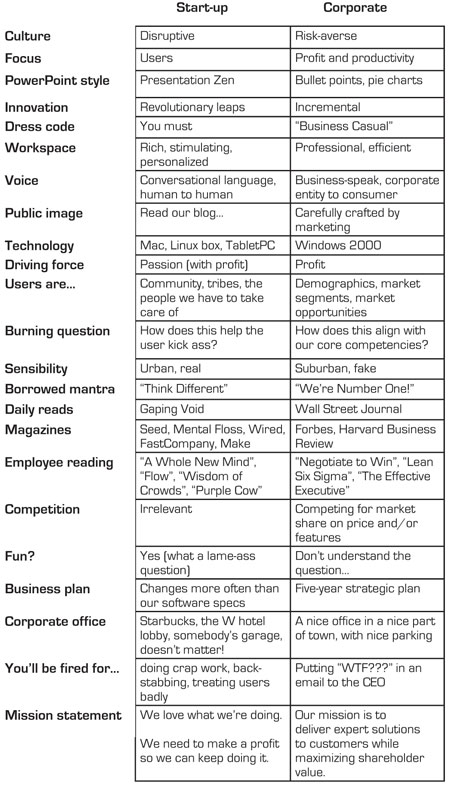
Kathy Sierra over at Creating Passionate Users created the chart below which illustrates the differences between the small start-ups we run, versus the large corporate powerhouses. An interesting point she made is that "When you evolve out of start-up mode and start worrying about being professional and dignified, you only lose capabilities. You don’t add anything…you only take away. Dignity is deadly."
We’ve all made mistakes
And I’m sure if they were all caught on tape they’d be just as entertaining as this video. It’s a collection of Steve Jobs’, and a couple buddies’, bloopers on stage.
OMG - It’s Hammertime!
That’s right, MC Hammer has a blog! His, his, his blog hits me so hard. Makes me say "Oh my Lord".
| older posts »